Originally reported on November 14, 2026, at 18:30 UTC+8. The account below describes EEZ as presented in the source at that time, not as an Ethereum protocol upgrade.
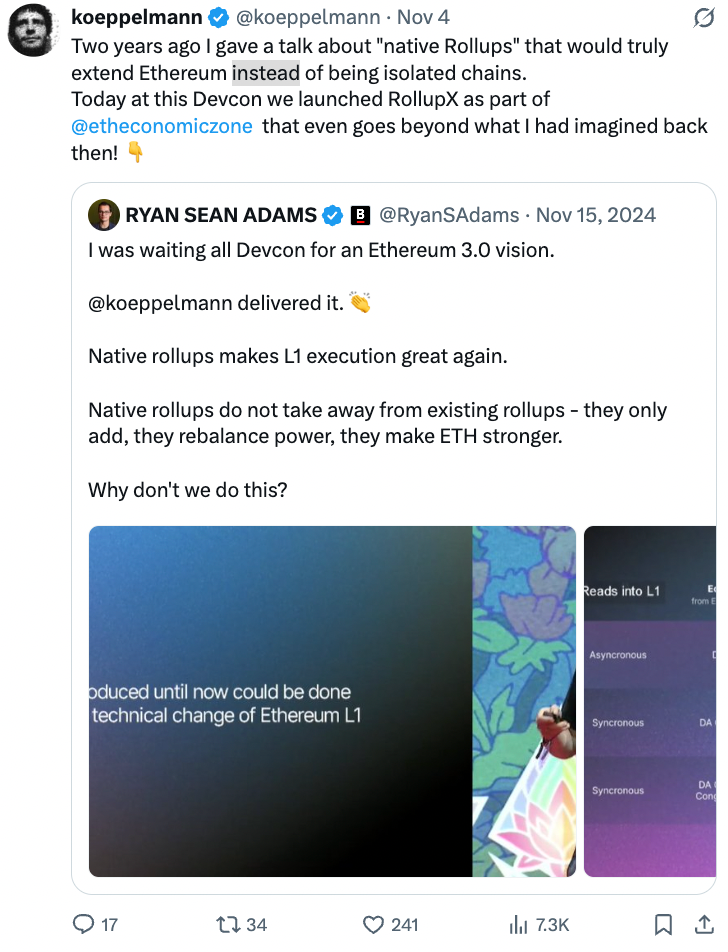
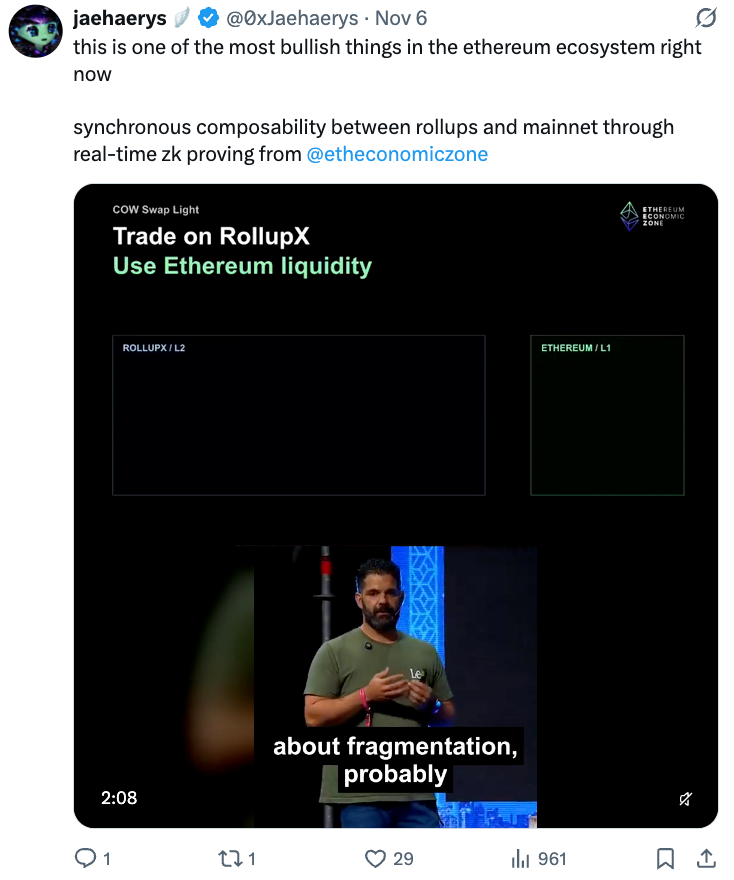
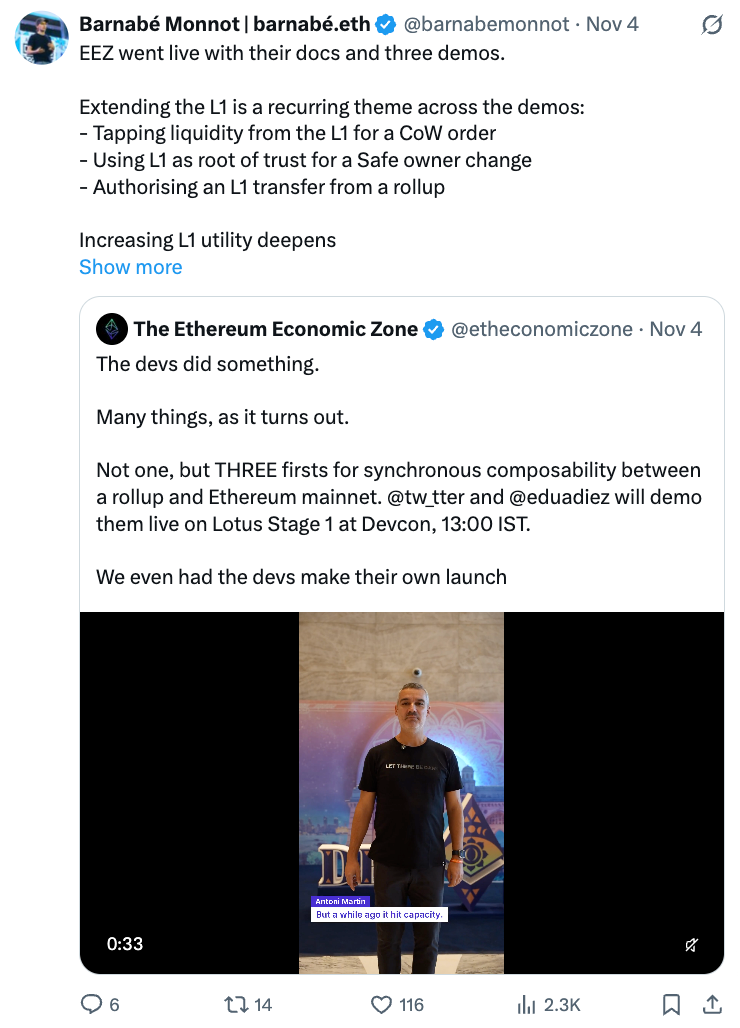
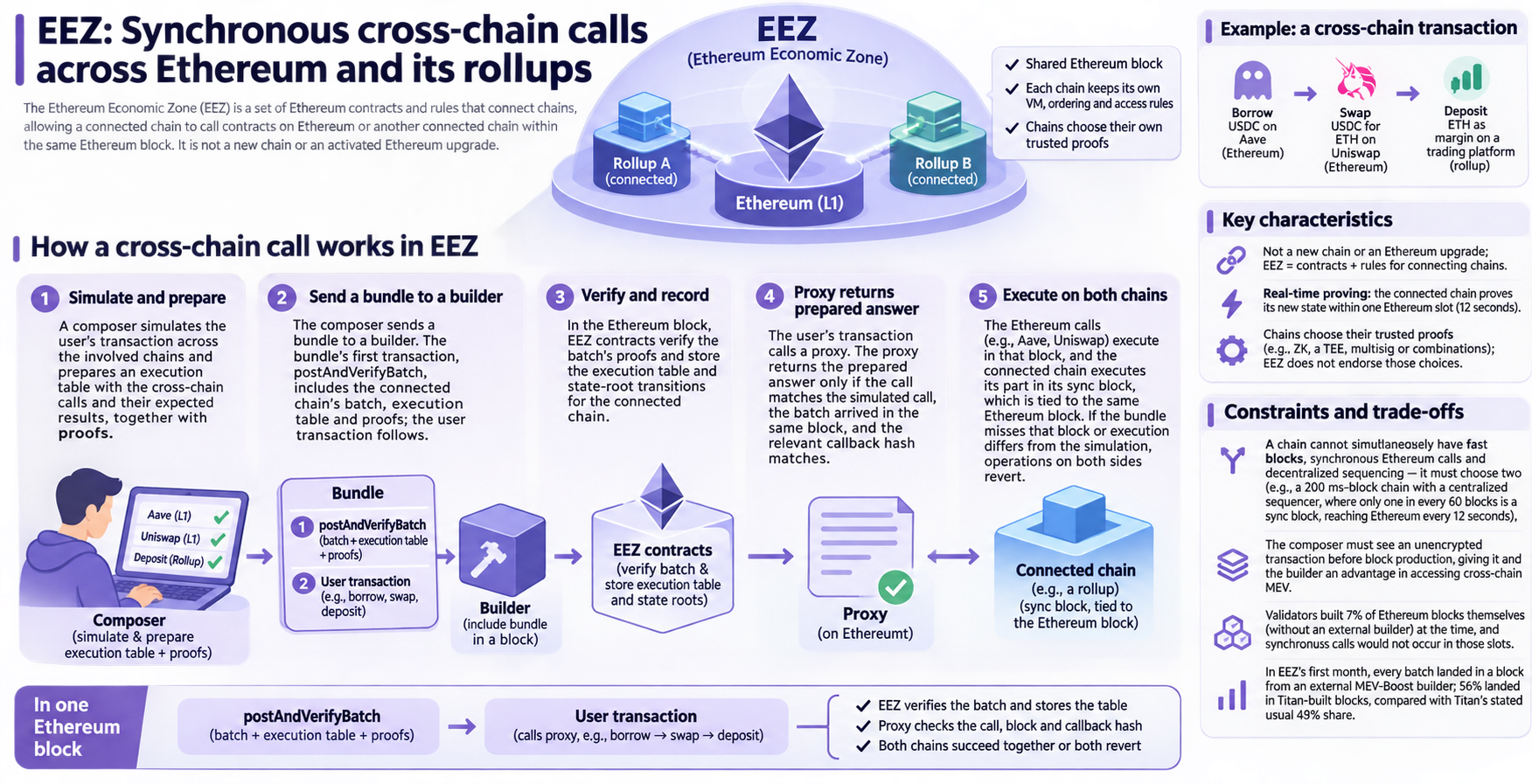
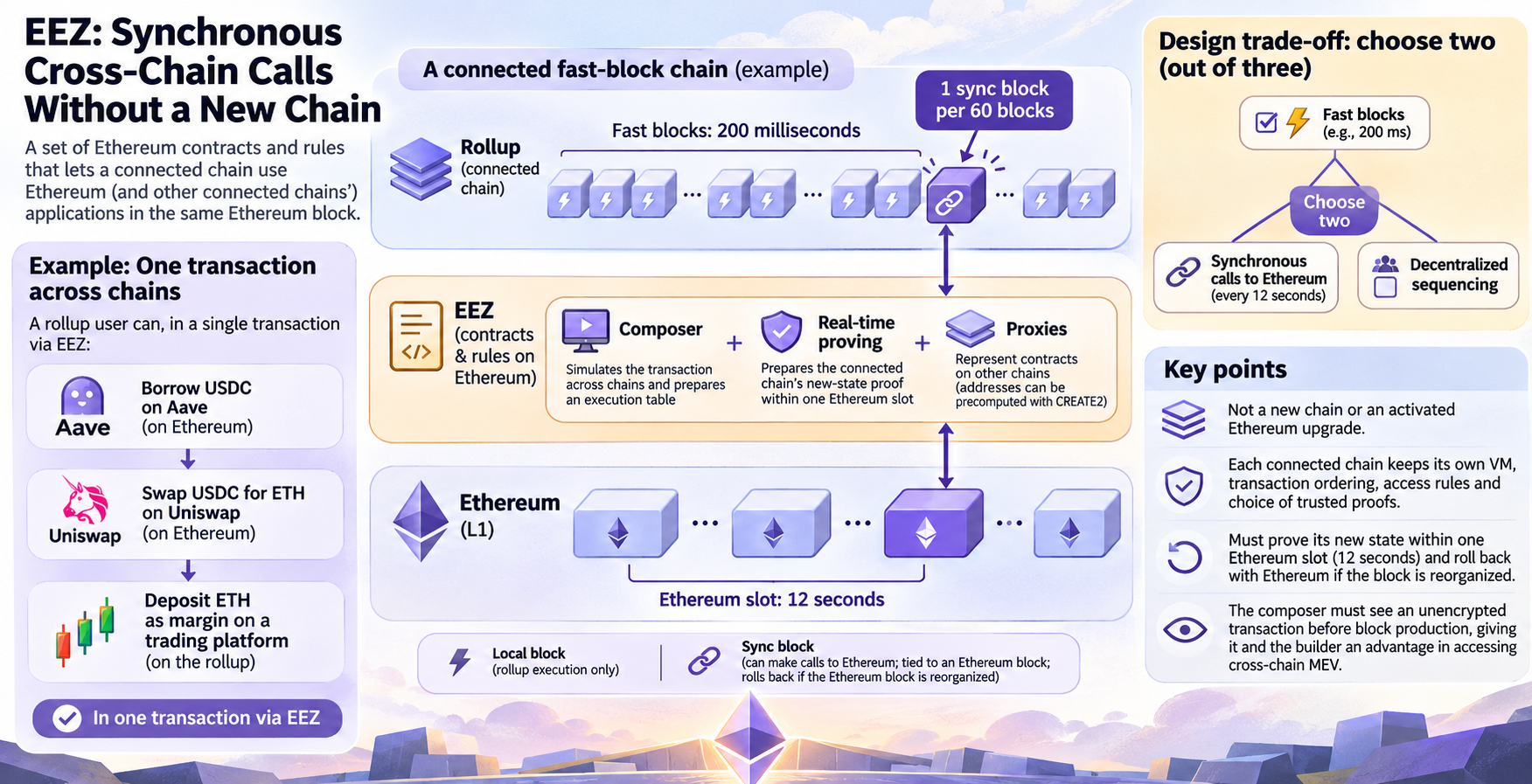
Liquidity and applications spread across Ethereum and its rollups cannot ordinarily be used together in a single synchronous transaction. The Ethereum Economic Zone (EEZ) is designed to address that separation: a connected chain could call contracts on Ethereum or another connected chain within the same Ethereum block. EEZ is a set of Ethereum contracts and rules for connecting chains, not a new chain or an activated Ethereum upgrade.
What a chain must do
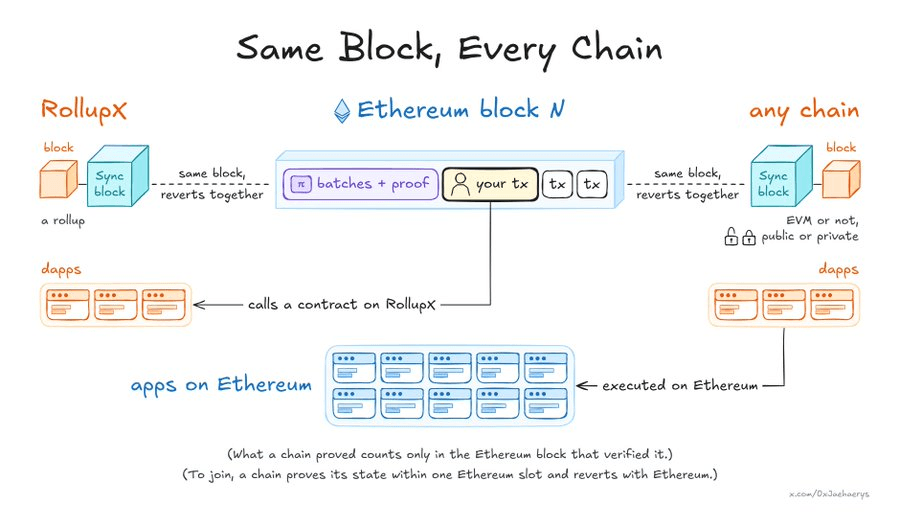
Under the design described by 0xJaehaerys, each connected chain keeps its own virtual machine, transaction ordering, access rules and choice of trusted proofs. To participate, it must prove its new state within one Ethereum slot—12 seconds—and roll back with Ethereum if that block is reorganized. The rollback requirement prevents one side of a cross-chain transaction from remaining after the other disappears. EEZ’s Ethereum contracts use proofs and state roots rather than executing the connected chain’s blocks themselves.
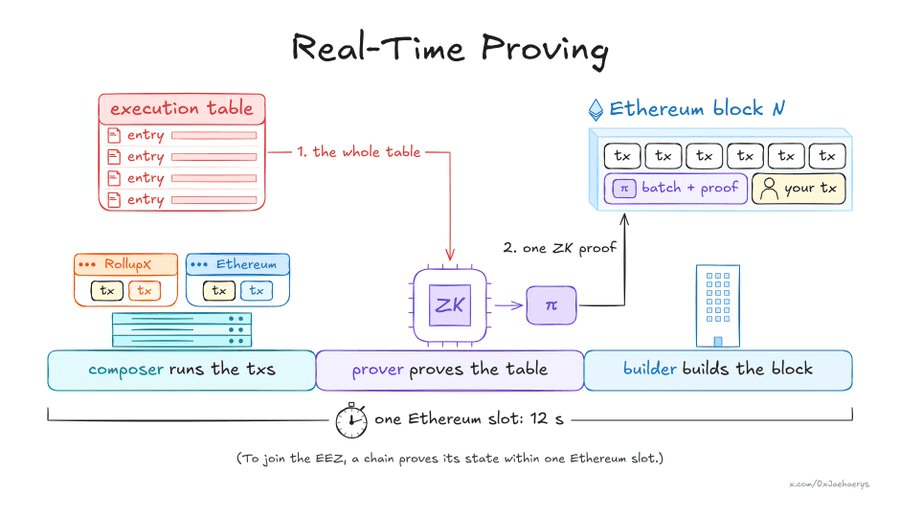
Three components make the proposed synchronous calls possible:
- Real-time proving prepares a chain’s new-state proof within an Ethereum slot. The article says ZisK’s cited hardware requirement fell from 24 RTX 5090 GPUs a year earlier to four at the time of reporting, citing Ethproofs.
- A composer simulates the transaction across the chains involved before block production and prepares an execution table containing the cross-chain calls and their expected results.
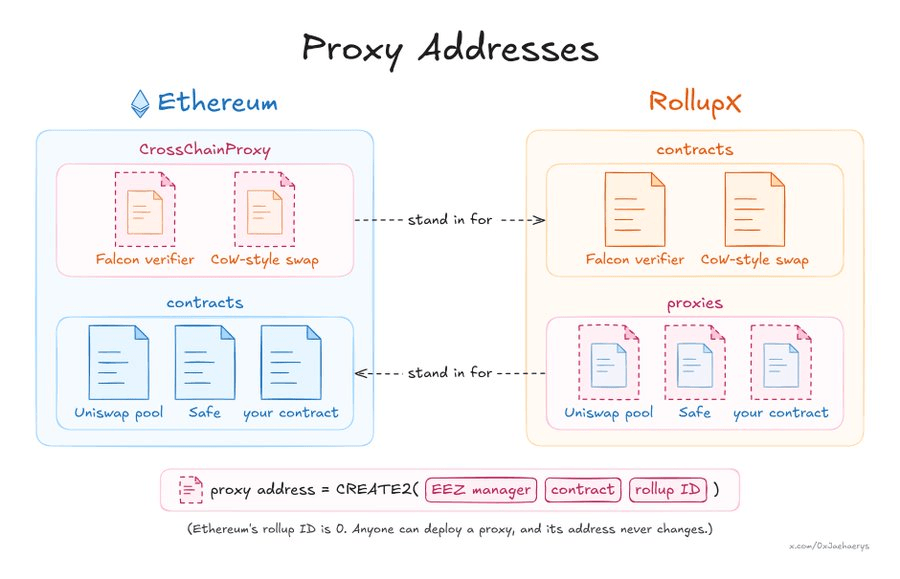
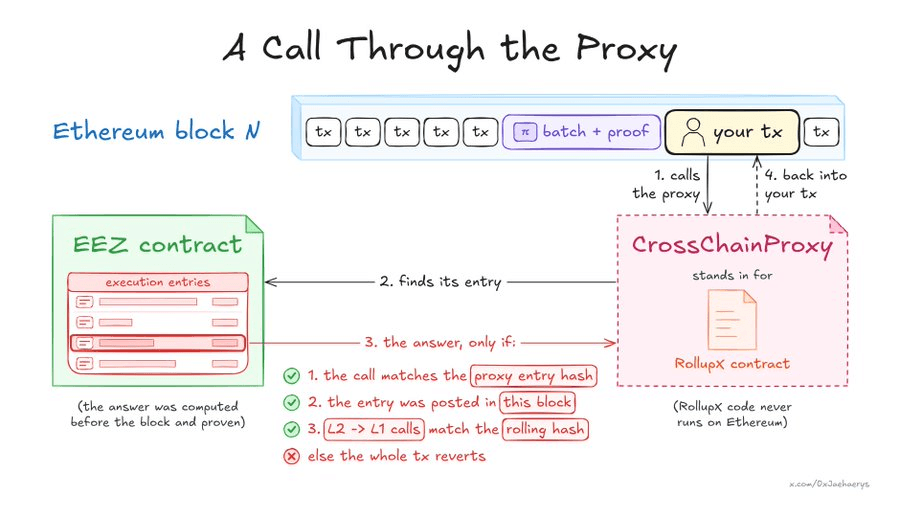
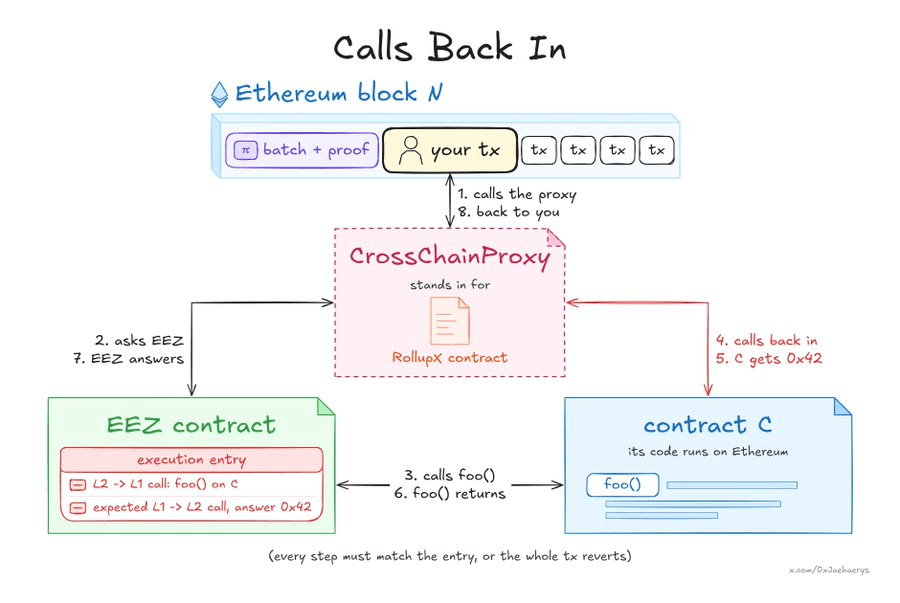
- Proxies represent contracts on other chains. Their addresses can be determined in advance using CREATE2, the EEZ contract address, the original contract address and a registered chain ID.
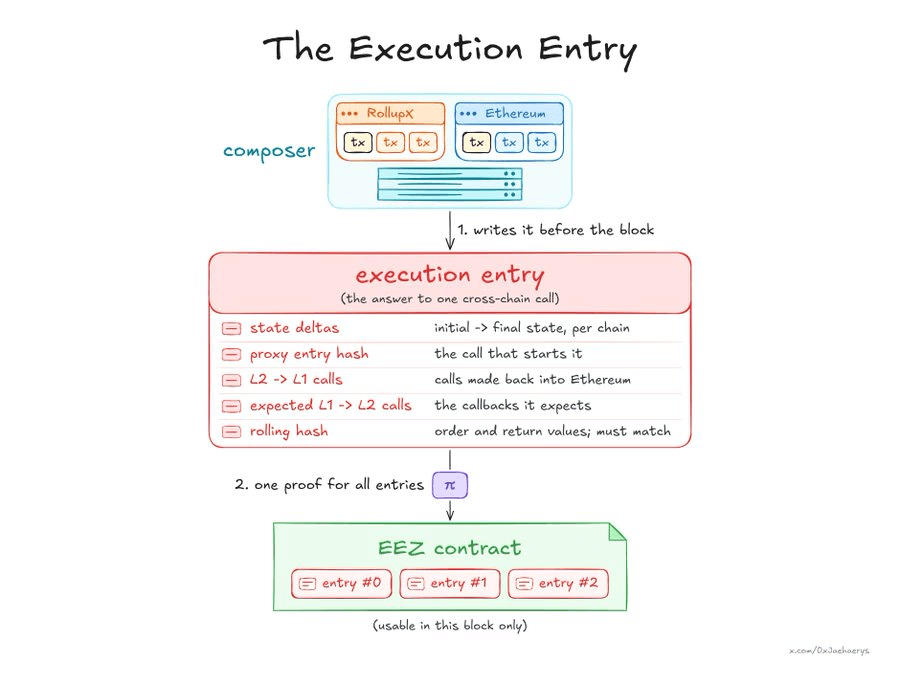
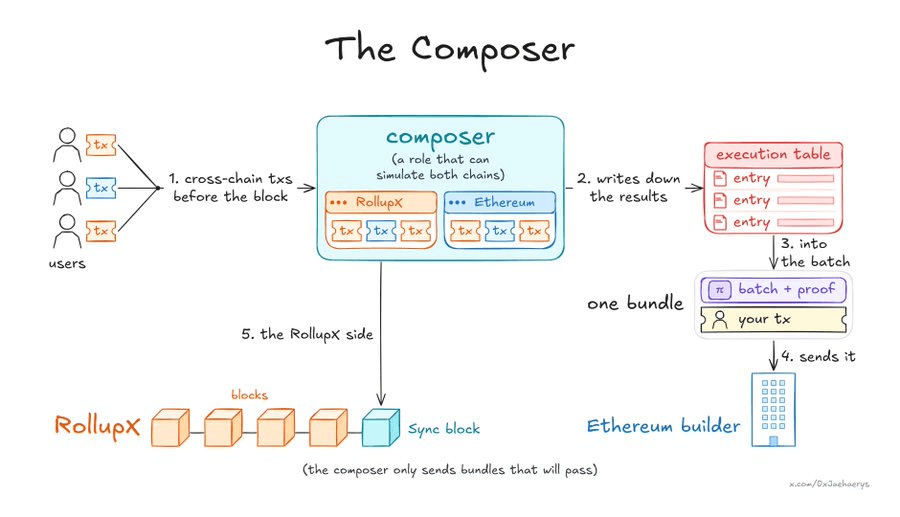
The composer sends a bundle to a builder. Its first transaction, postAndVerifyBatch, carries the connected chain’s batch, execution table and proofs; the user transaction follows. The EEZ contracts verify the batch and store the table and state-root transitions. A proxy returns a prepared answer only if the actual call matches the simulated call, its batch arrived in the same block, and the relevant callback hash matches. A connected chain’s sync block is tied to an Ethereum block and rolls back if its bundle misses that block.
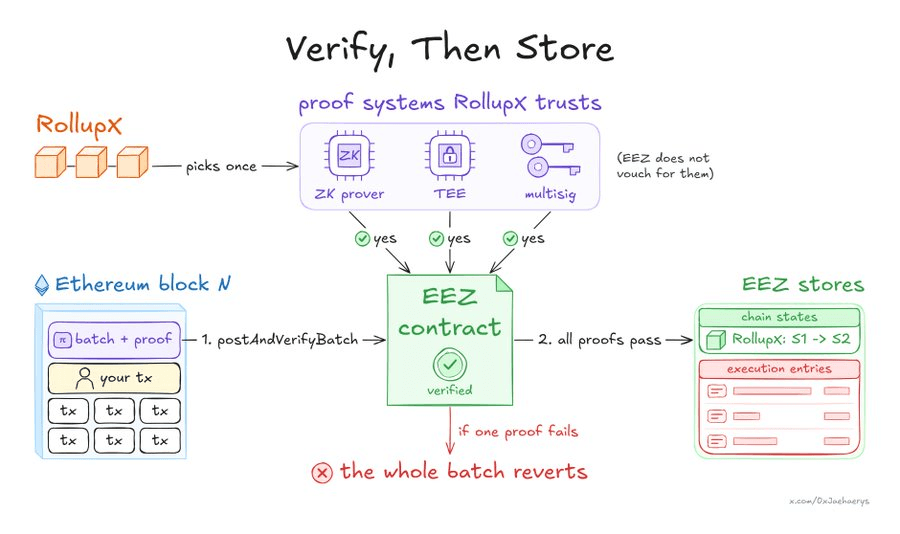
The chain owner decides which proof systems to trust—including ZK proofs, a trusted execution environment, multisignatures or combinations—and how many proofs a batch requires. The article explicitly says EEZ does not endorse those choices.
Uses described in the article
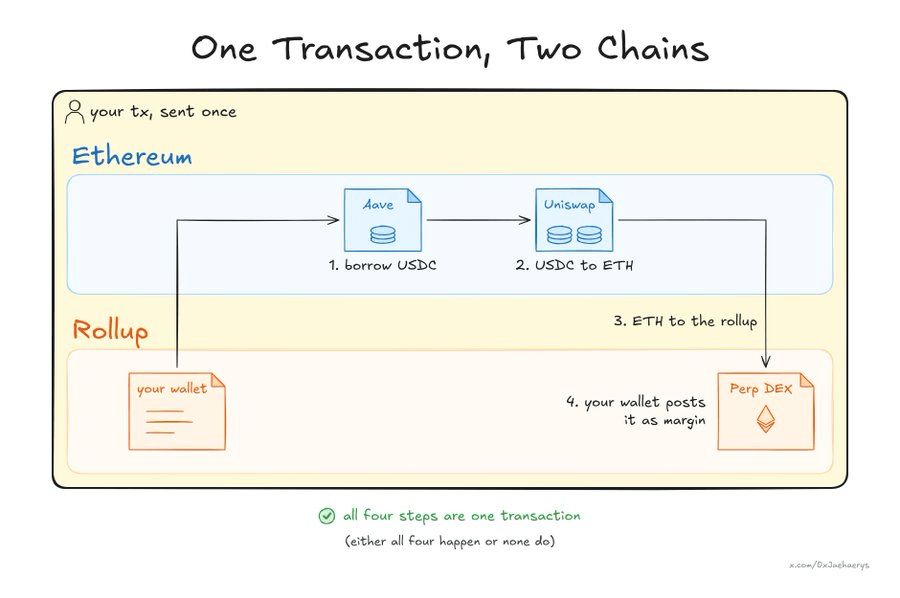
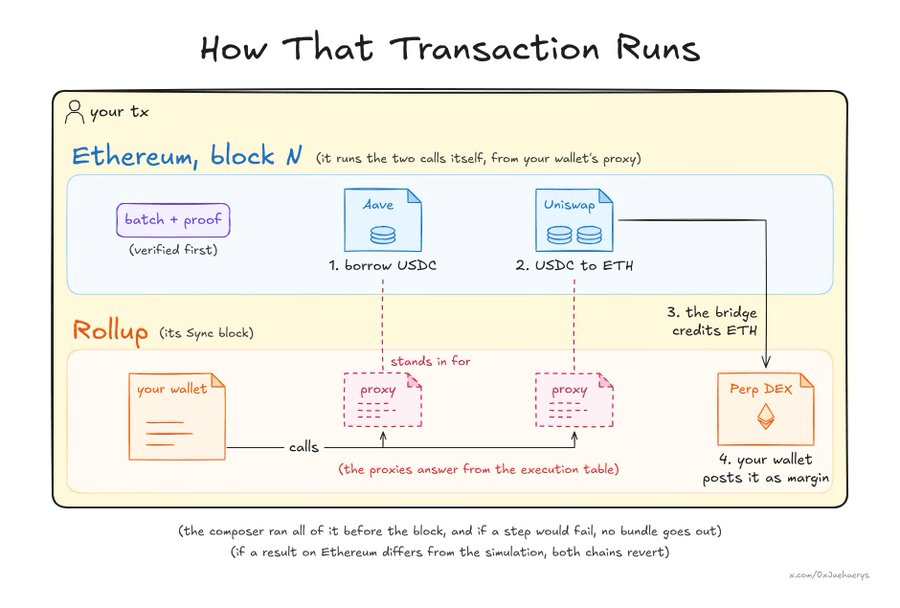
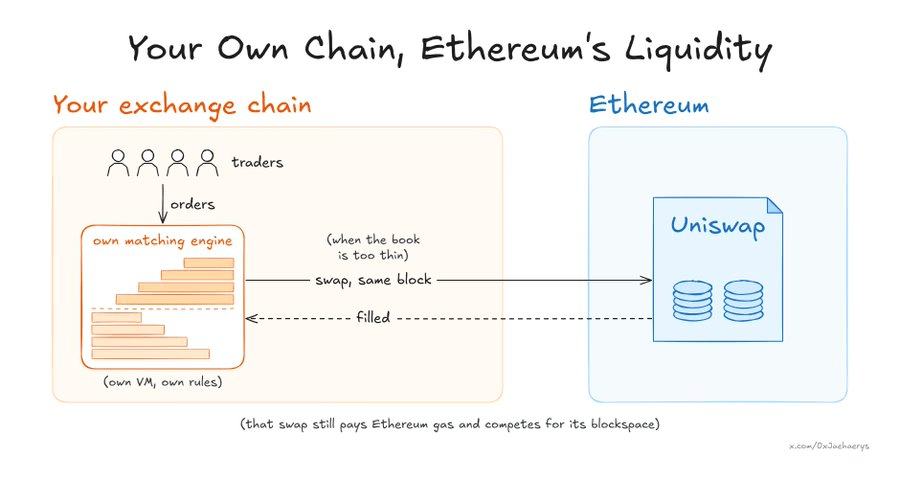
The opening example combines a rollup transaction with borrowing USDC from Aave on Ethereum, swapping it for ETH on Uniswap and depositing the ETH as margin on a trading platform. The composer prepares the calls across both chains; the bundle carries their proofs and expected results. The article says the borrower must already have collateral at the relevant Ethereum proxy address and pays the L1 gas cost through a higher tip to the composer. If simulation finds a failed step, the composer does not send the bundle; if Ethereum execution differs from the simulation, operations on both sides revert.
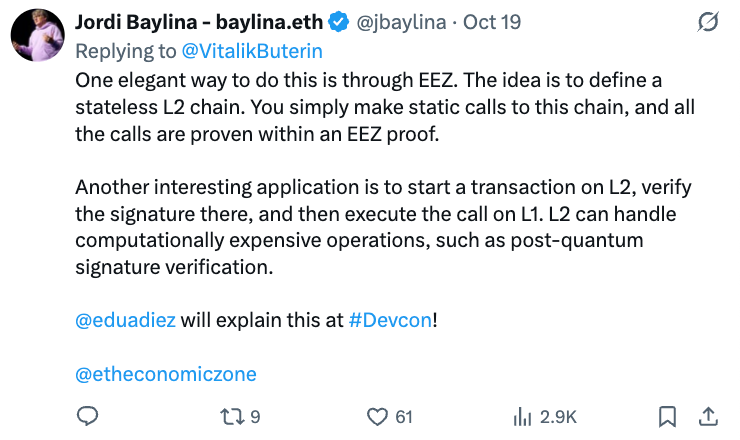
The article also reports several examples on RollupX: a purchase from an Ethereum Uniswap pool in which wrapped CRV was minted on the rollup in the same swap; a Safe configuration that reads its owner list from Ethereum for each rollup transaction; and Bermuda Bay, a privacy pool whose swaps execute on Ethereum’s Uniswap V3. It describes a demonstration in which a Falcon signature was verified on a rollup and the result authorized an L1 Safe payment. According to the article, verifying that signature on Ethereum would cost 5.5 million gas.
Constraints and trade-offs
Synchronous calls depend on Ethereum’s block timing and block space. The article says a chain cannot simultaneously have fast blocks, synchronous Ethereum calls and decentralized sequencing: it must choose two. It gives a 200-millisecond-block chain with a centralized sequencer as an example; only one in every 60 blocks would be a sync block, allowing its applications to reach Ethereum every 12 seconds.
The composer must also see an unencrypted transaction before block production, giving it and the builder an advantage in accessing cross-chain MEV. The article states that validators built 7% of Ethereum blocks themselves at the time, without an external builder, and that synchronous calls would not occur in those slots. It reports that every EEZ batch in its first month landed in a block from an external MEV-Boost builder; 56% landed in Titan-built blocks, compared with Titan’s stated usual 48% share.
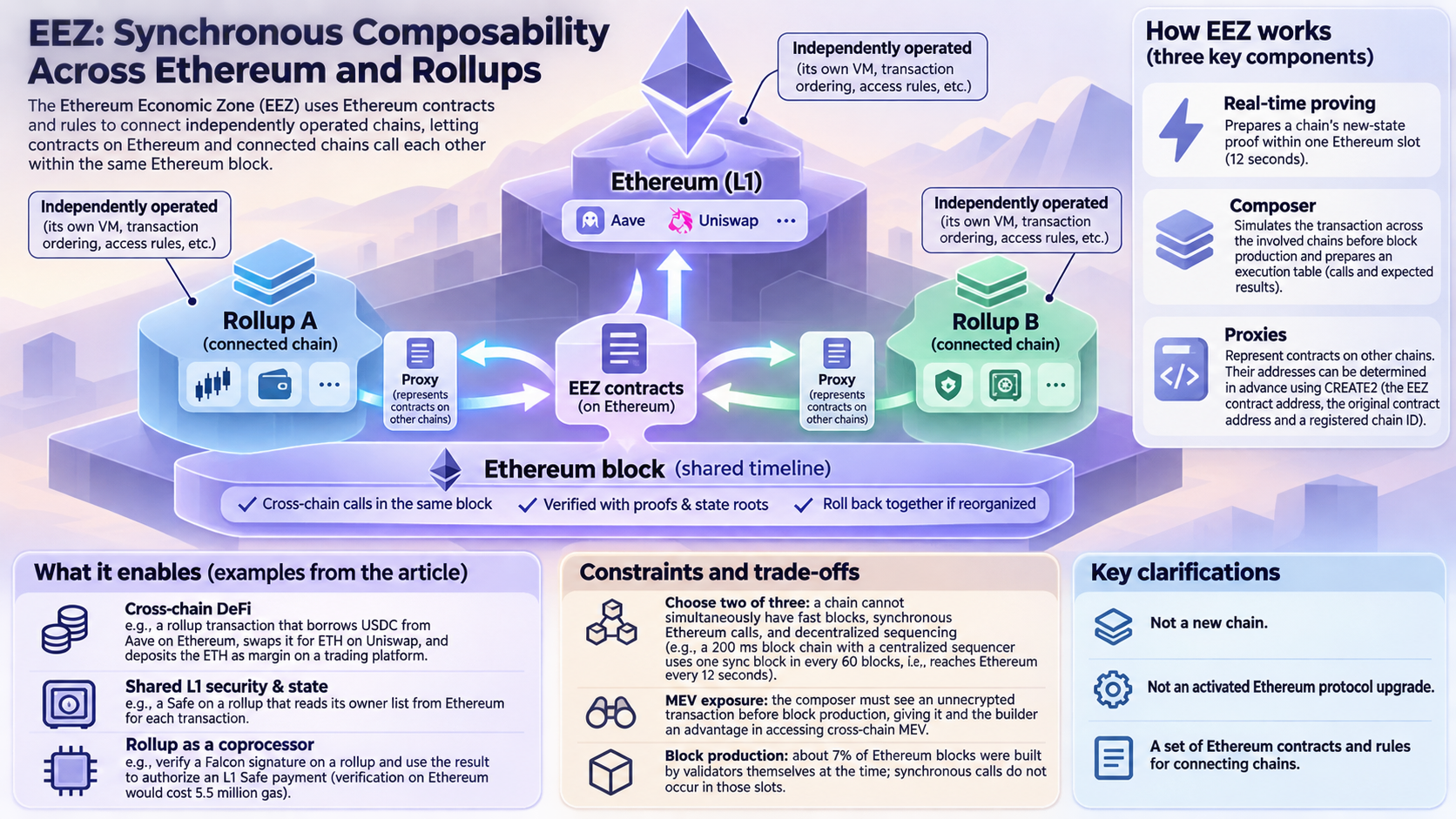
These are the source’s design description, examples and reported observations. They do not establish that EEZ is an EIP, a requirement for all rollups or a change activated across Ethereum.
Source: panewslab.com (originally published 2026-11-14 18:30 UTC+8)