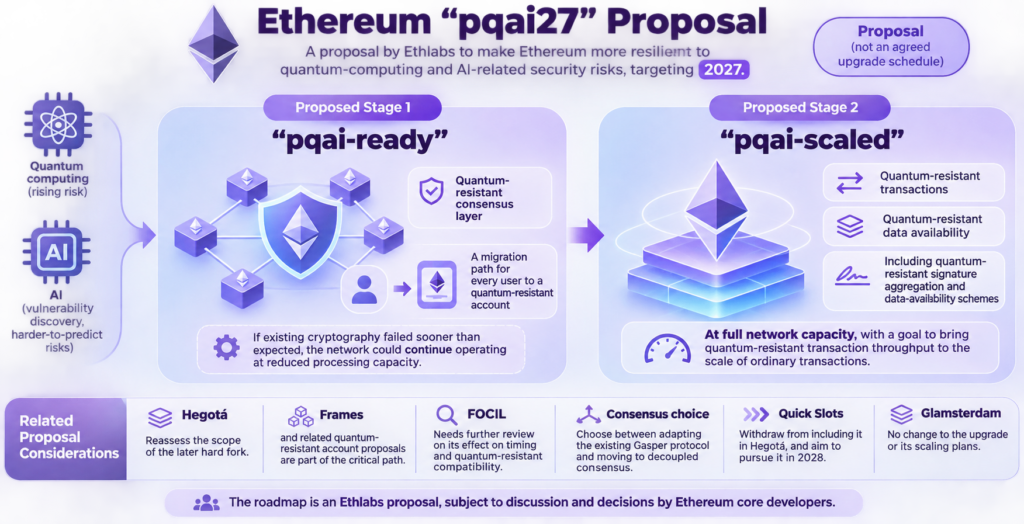
On November 12, 2026, Ethlabs proposed “pqai27” in an Ethereum developer forum post: a target for making Ethereum more resilient to quantum-computing and AI-related security risks by 2027. It is a proposal, not an agreed upgrade schedule.
Ethlabs argued that advances in quantum computing and AI-assisted vulnerability discovery warrant earlier protocol work. It said the US government had moved its quantum-risk target from 2035 to 2030 and that Google planned to achieve quantum resistance before 2029. Ethlabs also acknowledged that there is no evidence AI will necessarily break today’s cryptographic primitives; its concern is that the risk is difficult to predict.
The proposal separates the work into two stages:
- “pqai-ready” would make the consensus layer quantum-resistant and give every user a path to migrate to a quantum-resistant account. If existing cryptography failed sooner than expected, the network could continue operating at reduced processing capacity.
- “pqai-scaled” would support quantum-resistant transactions and data availability at full network capacity. Ethlabs’s goal is to bring quantum-resistant transaction throughput to the scale of ordinary transactions, including through quantum-resistant signature aggregation and data-availability schemes.
Ethlabs suggested reassessing the scope of the later Hegotá hard fork. It considers Frames and related quantum-resistant account proposals part of the critical path, while FOCIL’s effect on timing and quantum-resistant compatibility needs further review. Developers would also need to choose between adapting the existing Gasper consensus protocol and moving to decoupled consensus.
Ethlabs said it would withdraw its earlier push to include Quick Slots in Hegotá and aim to pursue the feature in 2028. It proposed no change to Glamsterdam or its scaling plans. The roadmap remains subject to discussion and decisions by Ethereum core developers.