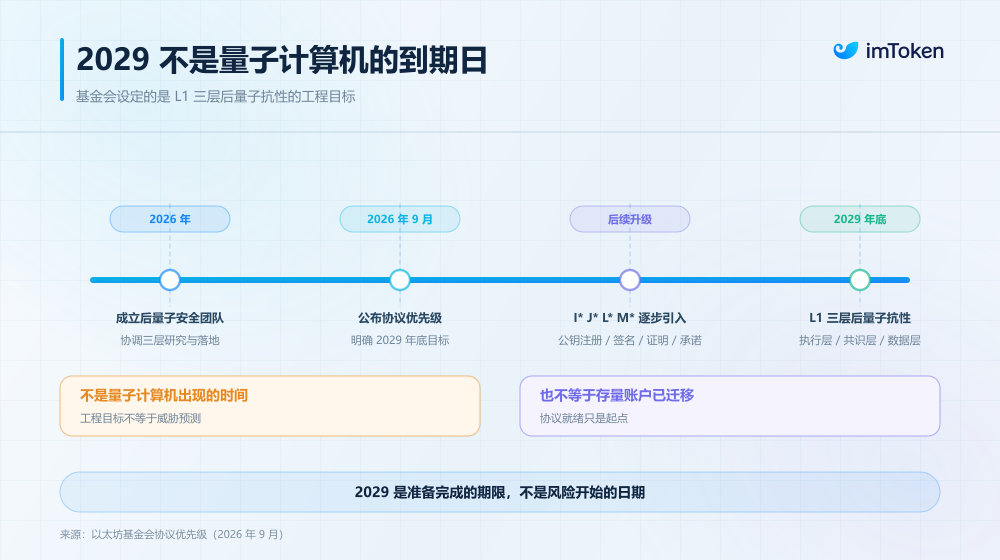
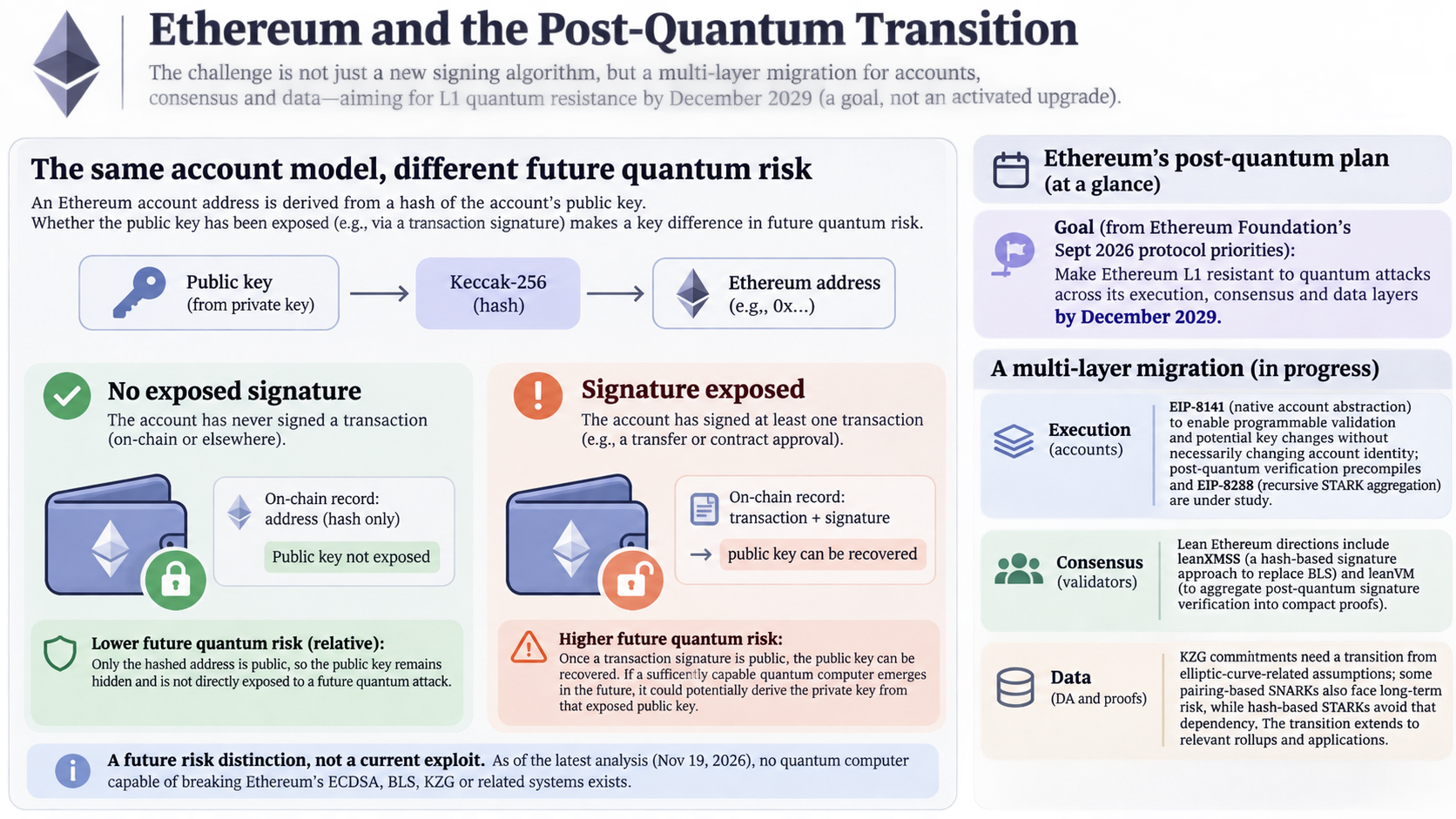
As of November 19, 2026, Ethereum’s post-quantum work remained a migration plan, not an activated network upgrade. In an analysis published that day, imToken described a goal it attributed to the Ethereum Foundation’s September 2026 protocol priorities: making Ethereum L1 resistant to quantum attacks across its execution, consensus and data layers by December 2029.
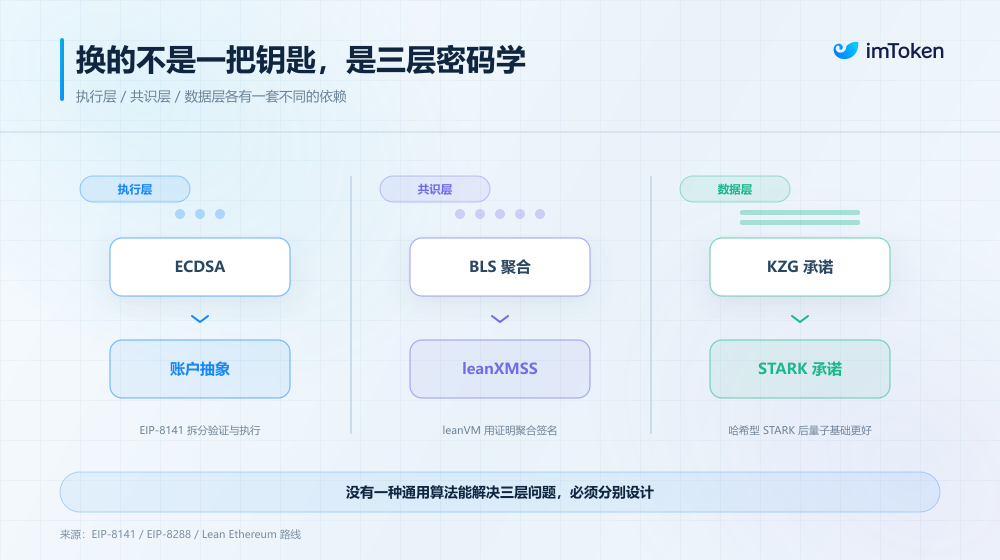
The challenge is broader than replacing one signing algorithm. Ethereum uses ECDSA for ordinary externally owned accounts, BLS signatures for proof-of-stake validators, and KZG commitments in blob data verification. Some zero-knowledge proof systems also rely on cryptographic assumptions that a sufficiently capable quantum computer could threaten. imToken noted that no quantum computer capable of breaking these systems existed at the time of its report.
Accounts: changing keys without losing continuity
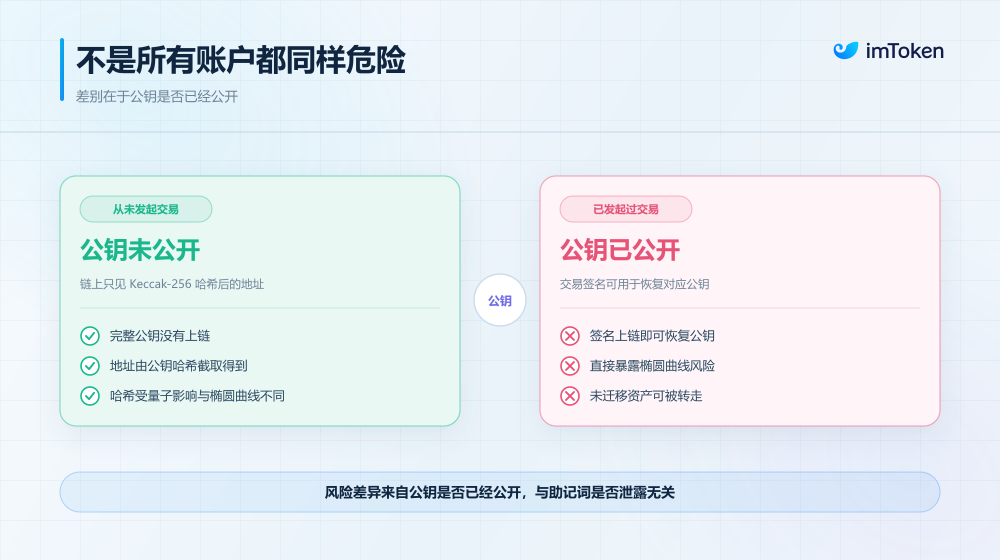
An ordinary Ethereum account uses an ECDSA signature to authorize transactions. Its address is derived from a hash of its public key, so an account that has never signed a transaction or exposed a signature elsewhere does not have the same public-key exposure as one that has signed. Once a transaction signature is public, its public key can be recovered. That distinction matters if a future quantum computer can derive private keys from exposed public keys.
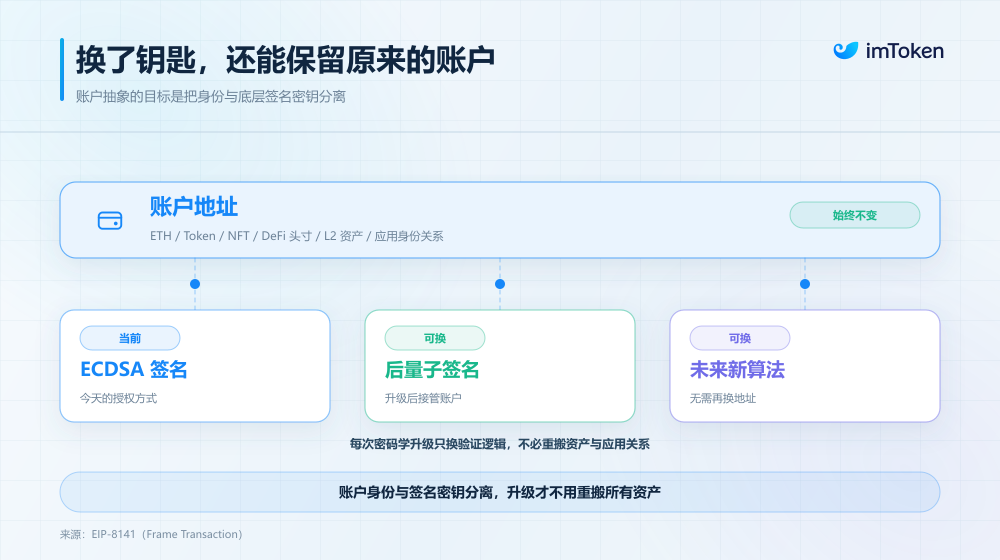
Simply moving to a new signing scheme could mean moving to a new address—and dealing with tokens, NFTs, DeFi positions and application permissions tied to the old one. imToken pointed to EIP-8141, a native account-abstraction proposal, as a possible way to separate transaction validation, execution and gas payment. Programmable validation could allow accounts to change how they authorize transactions without necessarily changing their identity. That is a proposed capability, not a feature already available to every Ethereum account. Post-quantum signature-verification precompiles are also under study; EIP-8288 proposes recursive STARK aggregation to reduce the burden of verifying larger post-quantum signatures.
Consensus and data need different tools
Replacing validator BLS signatures presents a separate scaling problem: much larger signatures could raise network propagation, storage and verification costs. The Lean Ethereum directions described by imToken include leanXMSS, a hash-based signature approach intended to replace validator BLS signatures, and leanVM, intended to aggregate post-quantum signature verification into compact proofs. Neither is described as an activated consensus change.
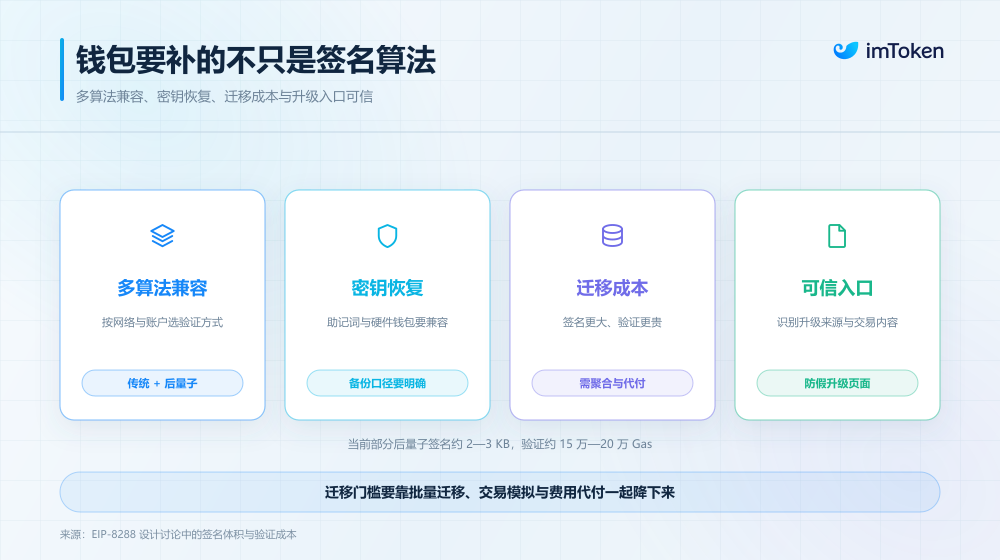
The data layer also needs attention because KZG commitments depend on elliptic-curve-related assumptions. At the application layer, some pairing-based SNARKs face a similar long-term concern, while hash-based STARKs avoid that particular dependency. A transition would therefore extend beyond L1 to relevant rollups and applications.
The migration problem remains open
Ideally, an account owner would authorize a new post-quantum key while their existing key is still secure. If an attacker could already forge signatures from that key, the old signature alone could no longer establish who controls the account. Dormant accounts, lost keys and owners unaware of a migration pose harder questions; imToken described possible treatment of unmigrated assets, including freezing, as disputed rather than decided.
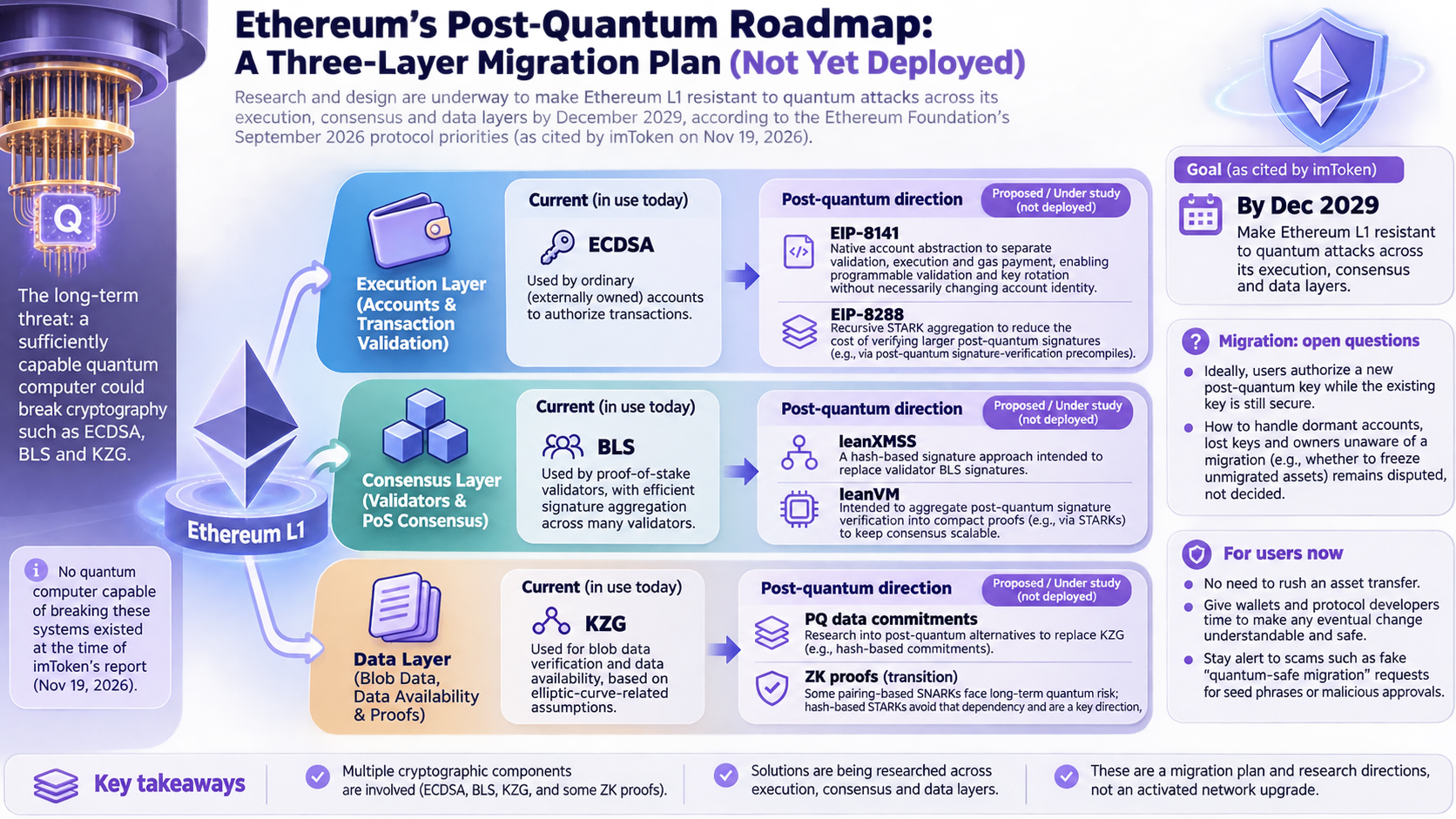
For users, the report’s immediate conclusion was not to rush an asset transfer. It was that wallets and protocol developers need time to make any eventual change understandable and safe—including protecting users from fraudulent “quantum-safe migration” requests for seed phrases or malicious approvals.