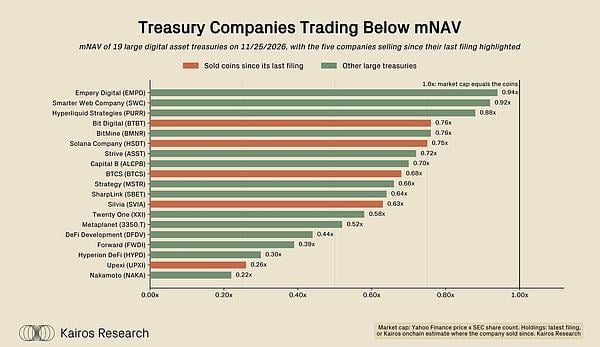
BTCS and Bit Digital sold ETH to pay down loans from Aave and Galaxy, respectively, according to their November securities filings. A Kairos Research analysis published on November 26, 2026, at 14:02 UTC+8 also identified what it considered likely BTC and SOL sales by three other listed treasury companies. Those companies had not confirmed the sales.
Across all five companies, Kairos estimated sales of about 410 BTC, 57,300 ETH and 986,000 SOL over several weeks. Its $203 million estimate uses prices on the dates the assets moved, not reported cash proceeds.
What the ETH filings confirm
BTCS disclosed in a November 23 Form 8-K that it had sold about 27,300 ETH on November 20 to repay $43.8 million borrowed on Aave. The sale amounted to nearly half its reported end-September ETH holdings and came when ETH traded near $1,561.
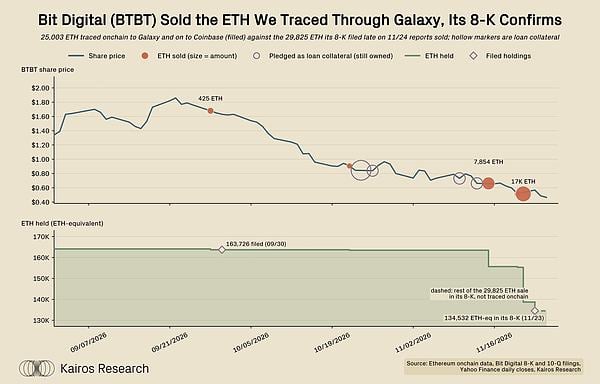
Bit Digital disclosed on November 24 that it had sold 29,825 ETH worth about $50 million between November 15 and 23, cutting its $100 million Galaxy loan in half. Kairos estimated that the ETH collateral had been worth about 131% of the outstanding loan at the time of sale.
Bit Digital’s filing provided a check on what wallet tracking could establish. Before the disclosure, Kairos had identified 24,793 ETH moving through Galaxy from November 15 to 21, about 83% of the eventual sale total. It had separately identified 69,088 LsETH as collateral rather than a sale; Bit Digital reported pledging 69,089 LsETH. The remaining balance was harder to gauge: Kairos estimated holdings equivalent to about 138,900 ETH, against the company’s disclosed 134,532 ETH.
Why Kairos classified other transfers as likely sales
Kairos matched treasury wallets and transfer routes to transactions the companies had previously reported. The method reproduced Silvia’s disclosed third-quarter sale of 320 BTC and put Solana Company’s first-quarter sales at $5.459 million, close to the reported $5.452 million. The evidence for subsequent sales varied by company:
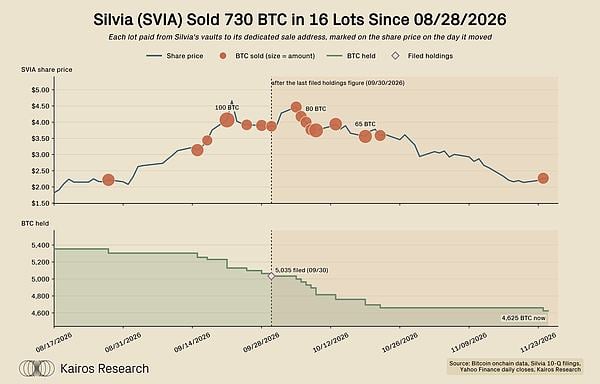
- Silvia (SVIA), formerly ProCap Financial: Nine transfers totaling 410 BTC, or about 8% of holdings, went to the same address. Each was between 35 and 80 BTC. Kairos said the address had received every previously identified Silvia sale and received transfers only from Silvia wallets.
- Upexi (UPXI): On November 15, Upexi sent 329,499 SOL to a shared BitGo hot wallet. Over the next 36 hours, the wallet sent 352,530 SOL to dealers and exchanges. Upexi supplied 96% of the wallet’s inflows over the three-day period, and no funds returned within ten days. Kairos inferred a sale of about 15% of Upexi’s holdings, but the pooled wallet did not identify which client’s assets funded each outgoing transfer.
- Solana Company (HSDT): A transfer of 465,976 SOL to FalconX was followed within a day by transfers of an equivalent amount to OKX and Kraken deposit addresses. No funds returned within eight days. Kairos classified the roughly $33 million transfer as a sale with moderate-to-high confidence. A collateral or lending transfer remained possible, though the company’s filing said its options margin and Maple loan collateral were held in custody accounts in its own name.
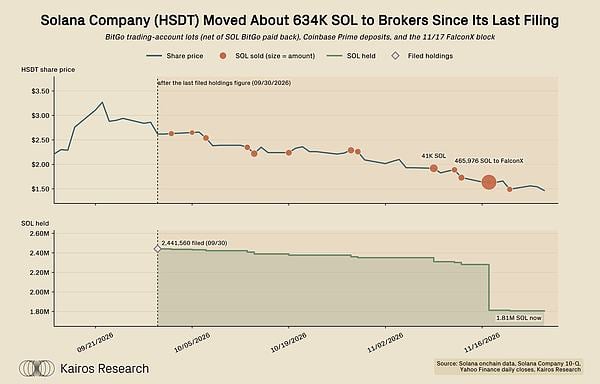
The timing suggested financing pressure to Kairos, but did not establish the motive for an unconfirmed sale. Upexi’s transfer came with SOL near $70. Kairos estimated that at about $67, collateral on Upexi’s $57.3 million BitGo loan would reach the 150% threshold at which the lender could issue a margin call. The inferred sale was within 1% of the amount needed to restore coverage to 200%. Solana Company, meanwhile, unstaked SOL on the day put options it had sold on 390,000 SOL expired deep in the money, generating an estimated $12 million loss.
What the discount and the filings leave out
All five stocks traded below the reported value of their underlying crypto holdings. At a discount, issuing shares to buy more crypto can reduce the amount held per share. But selling crypto to buy shares back does not necessarily improve that measure either.
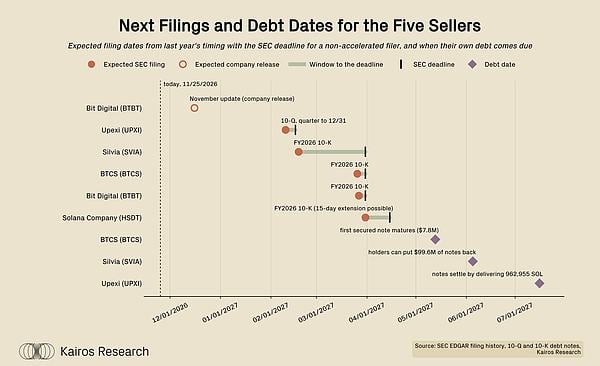
Silvia disclosed spending $24.4 million to repurchase 6.1 million shares from October 1 to November 10. Kairos attributed about 375 BTC in treasury outflows over that period to funding the buyback. By its estimate, BTC per million shares edged down from about 62.2 at the end of September to 61.8 on November 10. After accounting for $99.6 million in convertible notes, Kairos put Silvia’s valuation at about 0.98 times net asset value, rather than the headline 0.63 times. On that basis, the shares had been repurchased near net asset value, not at a steep discount.
Silvia and Solana Company disclosed other subsequent events in their November quarterly filings but did not mention the transfers Kairos classified as sales. Upexi’s transfers began two days after its quarterly report. By contrast, Bit Digital filed its 8-K the day after its final sale. Kairos cautioned that the difference in disclosure did not establish a regulatory violation: whether a partial treasury sale falls outside ordinary business and requires an 8-K is a matter of judgment.
Wallet records can reveal changes before the next filing, but not every movement is a sale. On November 24, Solana Company unstaked another 218,539 SOL, worth about $14.5 million, from an Anchorage margin vault. Kairos had observed the same step four days before the earlier FalconX transfer. The unstaking itself did not establish that another sale had occurred; conversely, sales settled entirely within a custodian may leave no public blockchain transfer at all.