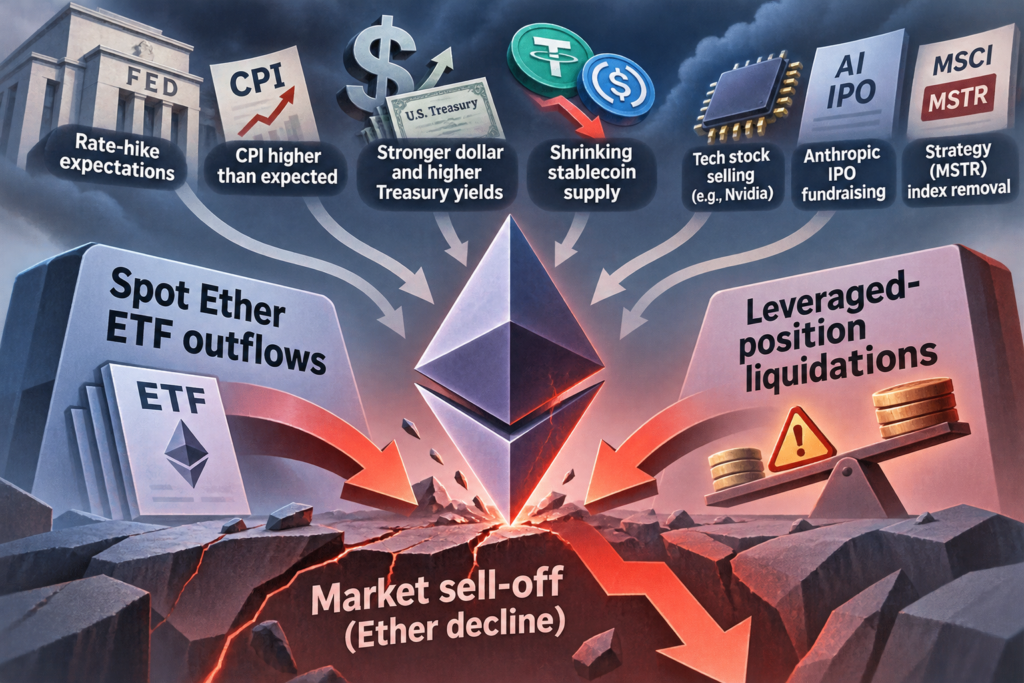
In its November 15, 2026 report, BlockBeats said Ether had fallen more than 10% over 24 hours, while Bitcoin briefly touched $62,000 after dropping more than 8%. Citing HTX market data, it reported more than $2 billion in crypto liquidations across over 320,000 accounts during the period.
The report did not identify a single trigger. It pointed instead to sustained spot ETF outflows, changing expectations for US interest rates and long-position liquidations that amplified the decline. This was a market sell-off, not an Ethereum protocol change.
ETF flows and interest-rate expectations
US spot Ether ETFs recorded approximately $399 million in net outflows for the week covered by the report, their seventh consecutive week of net outflows. US spot Bitcoin ETFs had seen seven consecutive trading days of net outflows through November 13, totaling about $1.91 billion. Their weekly outflows reached $1.07 billion, exceeding $1 billion for a second straight week. Bitcoin ETF outflows began on November 5, before the US CPI release.
US October CPI rose 0.4% month over month, while core CPI rose 0.3%; both figures exceeded market expectations, according to the report. The Financial Times reported that, by the preceding Friday, interest-rate markets had fully priced in a 25-basis-point Federal Reserve increase in December and largely priced in another in the following January. A week earlier, the implied probability of a January increase had been about 10%. Bank of America Global Research forecast 25-basis-point increases in December, January and March—a cumulative 75 basis points. Those were market expectations and a forecast, not announced Fed decisions.
The report also cited a stronger dollar and higher Treasury yields. At the November 13 close, it put the dollar index at 103.41, its highest since April 2025, and the US 10-year Treasury yield at 5.154%, after an intraday rise to 5.174%. Fed Governor Christopher Waller had said he favored a 25-basis-point December increase even if inflation improved, and that a roughly 0.3% or higher monthly core CPI reading warranted considering 50 basis points. The subsequently reported core CPI reading was 0.3%.
Liquidity and other possible pressures
DefiLlama data cited in the report put dollar-denominated stablecoin supply at about $287.1 billion on November 15, down roughly $4.4 billion over seven days, $16 billion over 30 days and $25.8 billion from its May peak. Over 30 days, USDT supply fell about $8.1 billion and USDC about $3.6 billion. Circle’s figures through November 12 showed USDC redemptions exceeding issuance by about $3.9 billion over 30 days. Glassnode had separately identified a $14.2 billion decline in stablecoin supply over the 30 days through November 9, calling it the fastest contraction since June 2022. The report interpreted shrinking stablecoin supply as a sign of less potential buying capacity within crypto markets.
BitMine chairman Tom Lee suggested that selling in Nvidia and other semiconductor shares might have prompted margin calls affecting crypto positions, particularly among Asian retail investors. He also cited an alleged $6.3 billion Binance crypto-asset theft as a potential factor, suggesting that some holders might move recovered funds into cash or stablecoins. These were Lee’s proposed explanations, not established causes of Ether’s decline.
Lee additionally suggested that investors might sell other holdings to fund participation in Anthropic’s proposed IPO and concurrent private placement, which the report said could raise up to about $90.4 billion. Bloomberg reported subscription orders of about six times the shares available. Separately, MSCI confirmed that Strategy (MSTR) would leave its US index after the November review, effective after the November 30 US market close. Strategy had disclosed that funds tracking relevant MSCI indexes held about 13 million of its shares, or 3.1% of basic shares outstanding; JPMorgan had estimated roughly $2.8 billion in potential passive selling. The index change does not require Strategy to sell Bitcoin. Any effect on its ability to raise equity to buy more Bitcoin remained a possibility, not a reported outcome.