
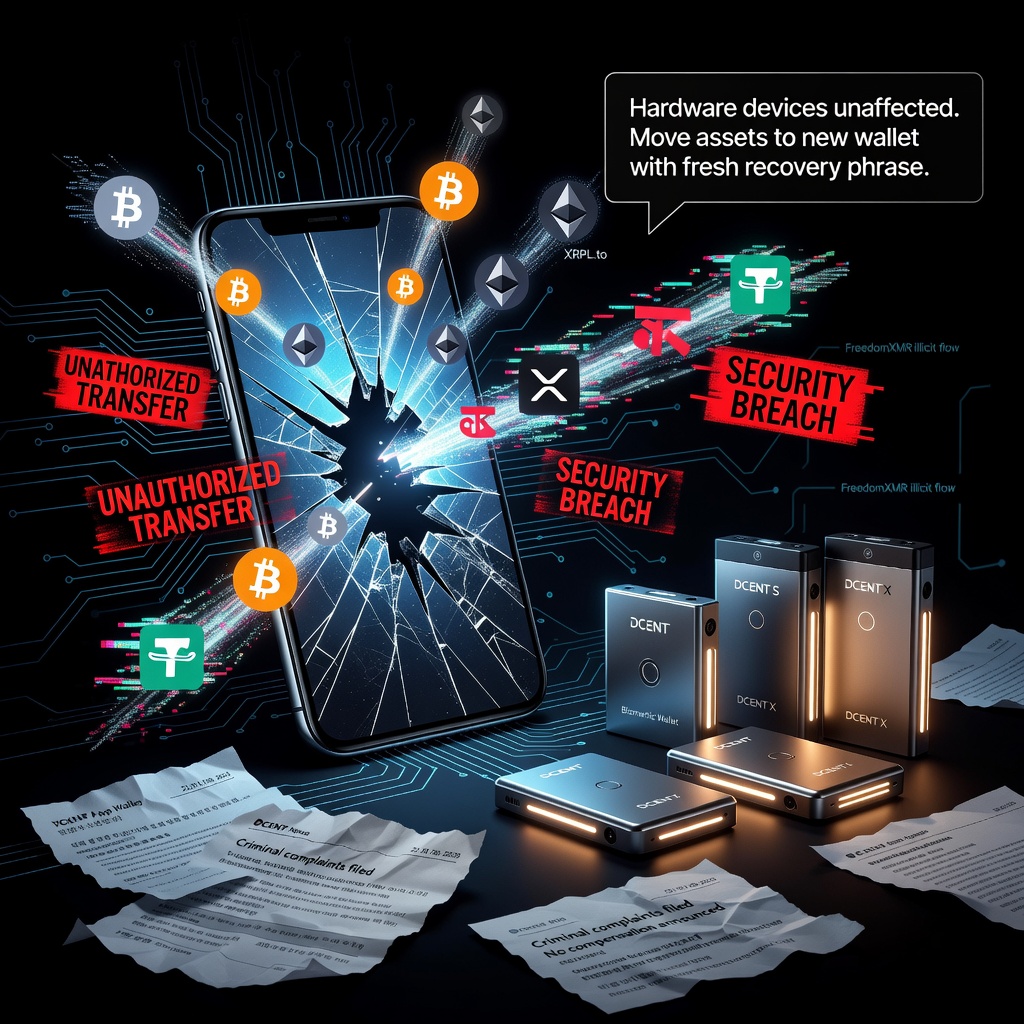
As of November 23, 2026, South Korean wallet provider DCENT was winding down its phone-only App Wallet after users reported unauthorized transfers of bitcoin, ether, XRP and other assets in September. Its operator, IoTrust, was asking App Wallet users to move their holdings to another wallet, Yonhap News Agency reported on November 22. No final shutdown date was specified. The mobile app would continue to support DCENT hardware wallets.
Which wallets are affected?
App Wallet users generate or import a recovery phrase on their phone and can authorize transfers there without a separate device. With a DCENT hardware wallet, the private keys stay on the device, and the user approves transfers on it. IoTrust said mobile connections to the DCENT Biometric Wallet, DCENT S and DCENT X would remain available. Continuing hardware services included an XRP Alliance integration with Flare that gave device users access to XRP-denominated yield vaults in May.
In a November 2 notice, DCENT said the incident did not affect the hardware devices themselves. It drew an important distinction for anyone who had entered the same recovery phrase into App Wallet: importing that phrase into a new hardware device produces the same private keys. DCENT advised those users to create a wallet with a new recovery phrase and transfer their remaining assets to it.
DCENT asked affected customers to update the app through an authorized app store before moving funds, transfer every token balance, however small, and confirm that their recovery information was backed up before deleting the old wallet.
What the investigation established
DCENT support began receiving reports of unauthorized transfers early on September 16. IoTrust issued an emergency notice that day, contacted law enforcement and asked exchanges to help trace transactions. Users inside and outside South Korea reported transfers involving bitcoin, ether, XRP, TRON and USDT.
According to Yonhap, blockchain analysis service XRPL.to traced approximately 12.728 million XRP linked to the suspected theft between September 15 and October 7. Yonhap valued that XRP at roughly 15.4 billion won. The estimate did not cover other assets. An October investigation also linked funds associated with the incident to suspected illicit flows through FreedomXMR. Neither finding established how the transfers were initiated.
In a September 17 report, DCENT identified transaction signing with app versions predating version 8.1.0, released in November 2025, as one of several possible risk indicators. Both Android and iOS users could be affected. Yonhap reported that IoTrust was examining whether weaknesses in random-number generation on older mobile operating systems played a role. More than two months after the first reports, neither the attack method nor the total losses had been established.
In November, DCENT said it had found no evidence of compromised hardware devices, altered app builds, intrusion into its servers or direct leakage of recovery phrases from its systems. IoTrust does not store customers’ recovery phrases. It supplied technical material to the Korea Internet & Security Agency and, according to Yonhap, made around 110 requests to exchanges and crypto swapping services to freeze suspected stolen funds. Those requests did not establish that funds had been recovered.
Criminal complaints and compensation
Some South Korean customers filed criminal complaints against IoTrust in mid-October. Around 20 others were seeking advice on joint action. A lawyer representing victims whose alleged losses together exceeded 1 billion won told Yonhap that the cases had been transferred to the National Police Agency’s Cyber Terrorism Investigation Unit.
The lawyer said a civil claim would require distinguishing any technical fault attributable to IoTrust from issues involving how users managed their recovery phrases. The difficulty of proving that operator fault was the sole cause warranted caution about a civil lawsuit, the lawyer said.
As of Yonhap’s November 22 report, IoTrust had announced no compensation arrangement. It warned users about fake support messages and reimbursement offers asking for recovery phrases or private keys.