In a November 26, 2026 litepaper, BNB Chain proposed a Layer 1 blockchain that would let users trade on supported public exchanges without revealing who owns the proceeds. The network would operate alongside BNB Smart Chain and use BNB as its native token. Rather than making exchange contracts private, the proposal changes how users fund a trade and receive the assets it returns.
What a block explorer would show
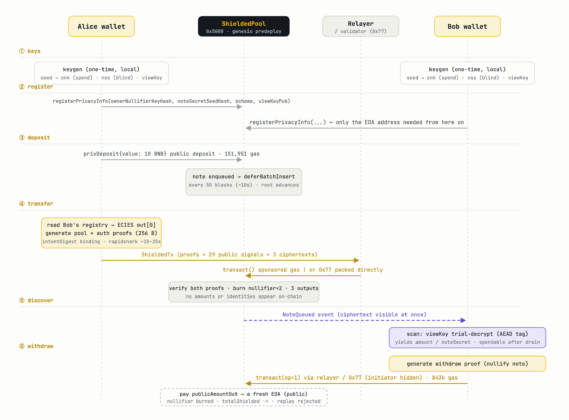
Consider a company depositing 10 BNB into the proposed network’s shielded pool. An observer could see the funding address and the amount deposited. If the company then paid a supplier inside the pool, neither party, the asset nor the amount would be public. The network fee might still be visible, depending on how the payment was submitted.
Inside the pool, encrypted records called notes would take the place of public account balances. Zero-knowledge proofs would let the network verify a payment without disclosing the details recorded in those notes.
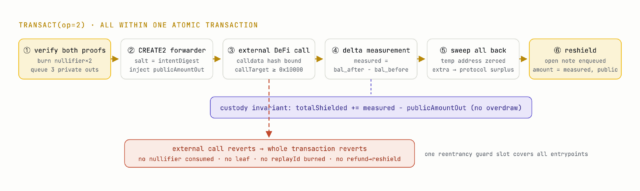
A swap would leave a different public record. Under the proposed AtomicCall mechanism, the company could spend 2 BNB from the pool at a supported exchange. The funds would leave the pool, interact with the exchange contract and return as the resulting asset, all in one transaction. An observer could inspect the contract, the instructions it received and the amounts exchanged. An open note would record the asset and quantity returned to the pool without identifying its owner.
That does not guarantee anonymity. In a quiet pool, an unusually sized deposit followed closely by a corresponding swap could give observers a way to connect the two. More users and transactions could make those clues less conclusive.
Which assets the documentation supports
The broader design includes BNB and selected BEP-20 tokens, but the developer documentation identifies only native BNB as a supported deposit asset in the implementation it describes. Stablecoin deposits remain a possibility, not a documented capability. That distinction matters for businesses that want to pay suppliers or settle invoices privately without taking on BNB price volatility.
The litepaper sets out the design rather than announcing a network launch. Beyond asset and application support, the project still needs to demonstrate the security of the circuits that verify private transactions, including through independent review.